
22 May – Beyond the Budget Series

Killian Carroll, Senior Economist
Spending overruns have become a regular feature of Ireland’s public finances. In this two-part series, we explore the root causes of these overruns. We begin with a broad look at recent developments at a headline level, while Part 2 takes a deeper look at health spending.
We will focus on the period from 2023 onwards, after Covid’s acute phase. High inflation contributed to overruns during this time, but as we’ll see, some overruns were entirely predictable.
How Large Have the Overruns Been?
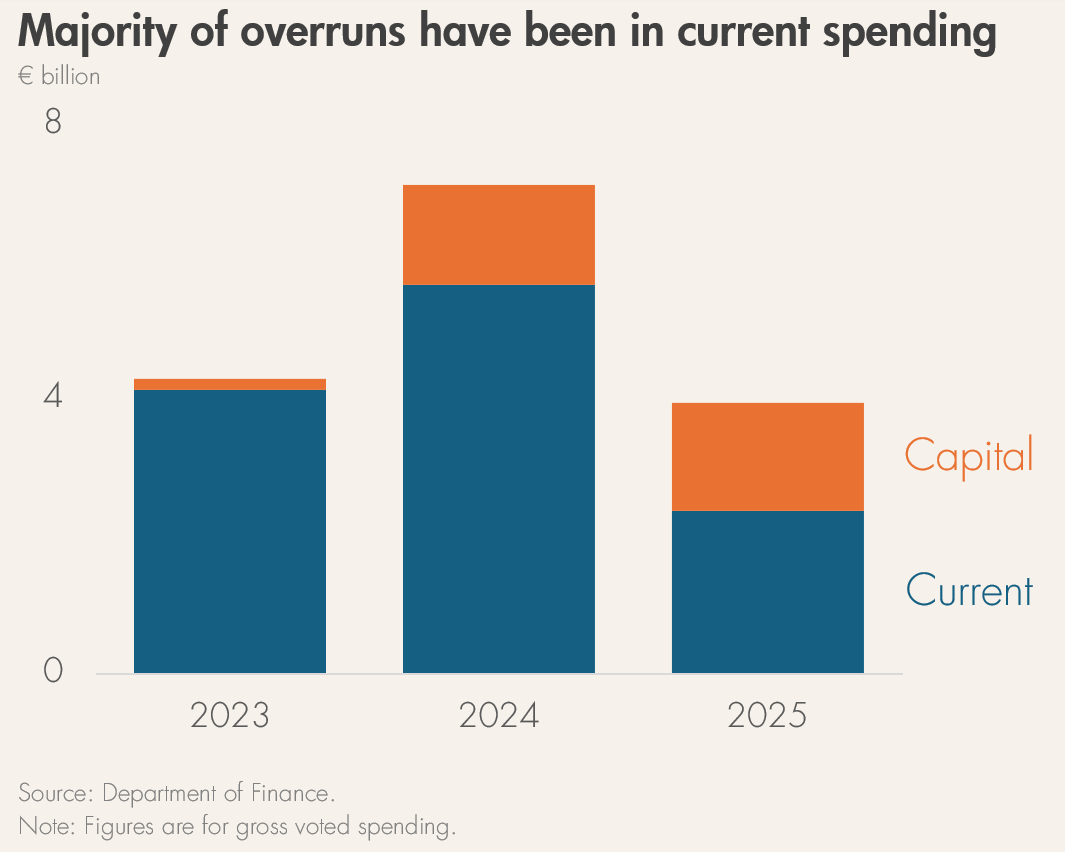
Since 2023, overruns have averaged €5.1 billion per year, with 2024 particularly striking at €7.1 billion. Most overruns, 80% on average, are driven by current spending rather than capital spending. Yet in 2025, capital spending accounted for 40% of the total overrun.
Why Do Overruns Happen?
Overruns occur for four main reasons:
- Unforeseen circumstances – shocks like inflation spikes
- New measures introduced mid-year – additional policy changes
- Bad planning/budgeting – inaccurate estimates from the start
- Poor expenditure management – weak oversight
Recent overruns reflect a mix of all four reasons. The first two are fairly innocuous: policymakers should respond to crises. The inflation spike meant government inputs cost more than anticipated. Nearly half the 2023 and 2024 overruns came from one-off cost-of-living measures, designed to provide immediate relief to households and businesses against high inflation.
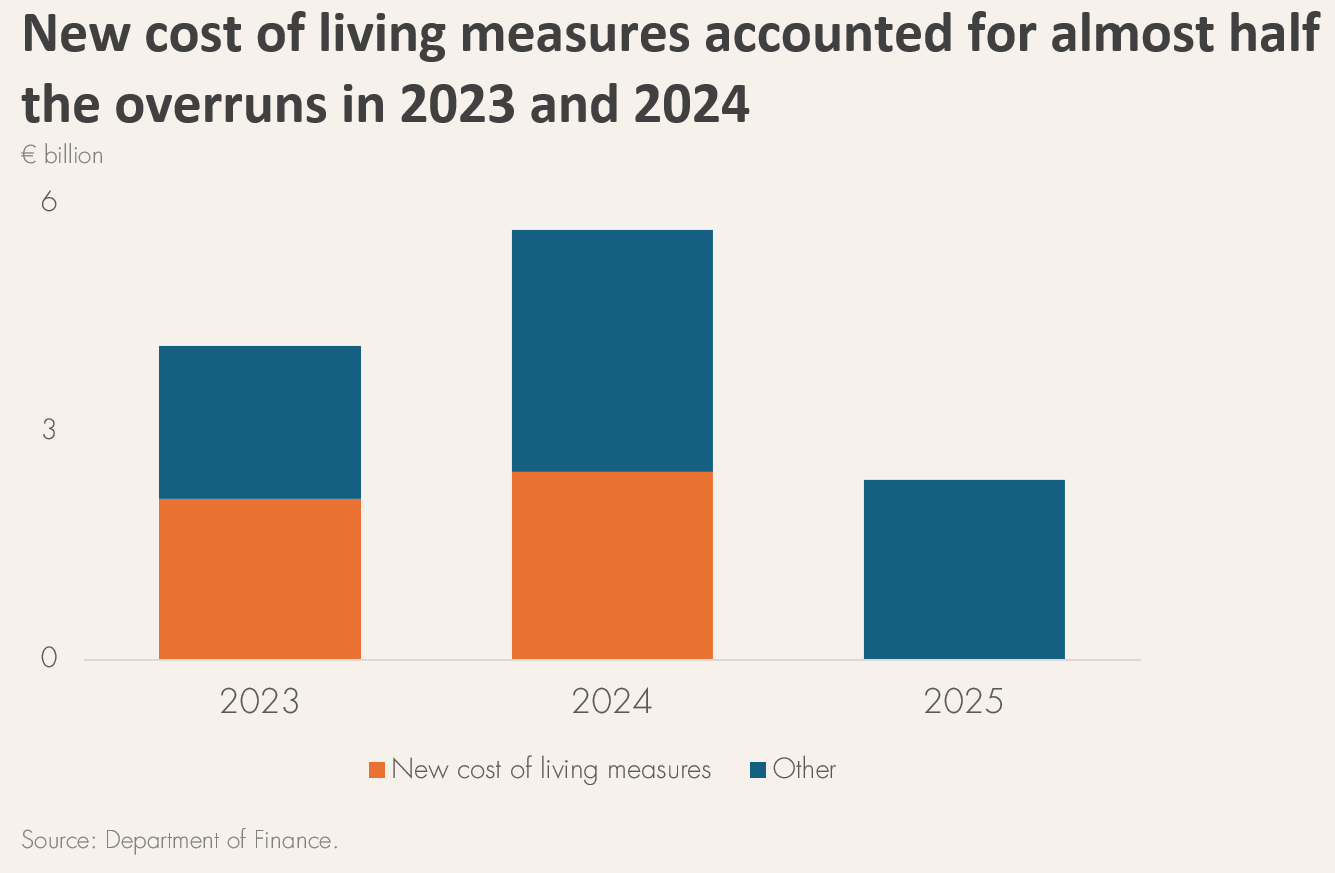
However, this leaves overruns of €2 billion in 2023, €3.2 billion in 2024 and €2.4 billion in 2025, that can be attributed to the final two reasons—bad budgeting and poor expenditure management. From a public finances perspective, these are the more egregious reason for overruns. For the rest of this blog, we’ll focus on one of these reasons, bad budgeting.
Do we have a bad budgeting problem?
Yes. The starting point has been persistently wrong.
Building next year’s budget requires having a good idea of what we are currently spending this year (the base year), and next year—prior to any new policy changes. Get the starting point wrong, and the end point will be wrong too. The government departments estimate this, and publish these figures in the White Paper on the Friday before Budget Day.
Have we been getting it right? No. Over the past three budgets, the base year has been significantly underestimated at the time of the budget. Between the forecasts on Budget day and the end of the year, current spending has overrun by an average of €0.75 billion. That’s a significant forecast error for a three-month window, in which there hasn’t been any policy changes. This is bad budgeting.
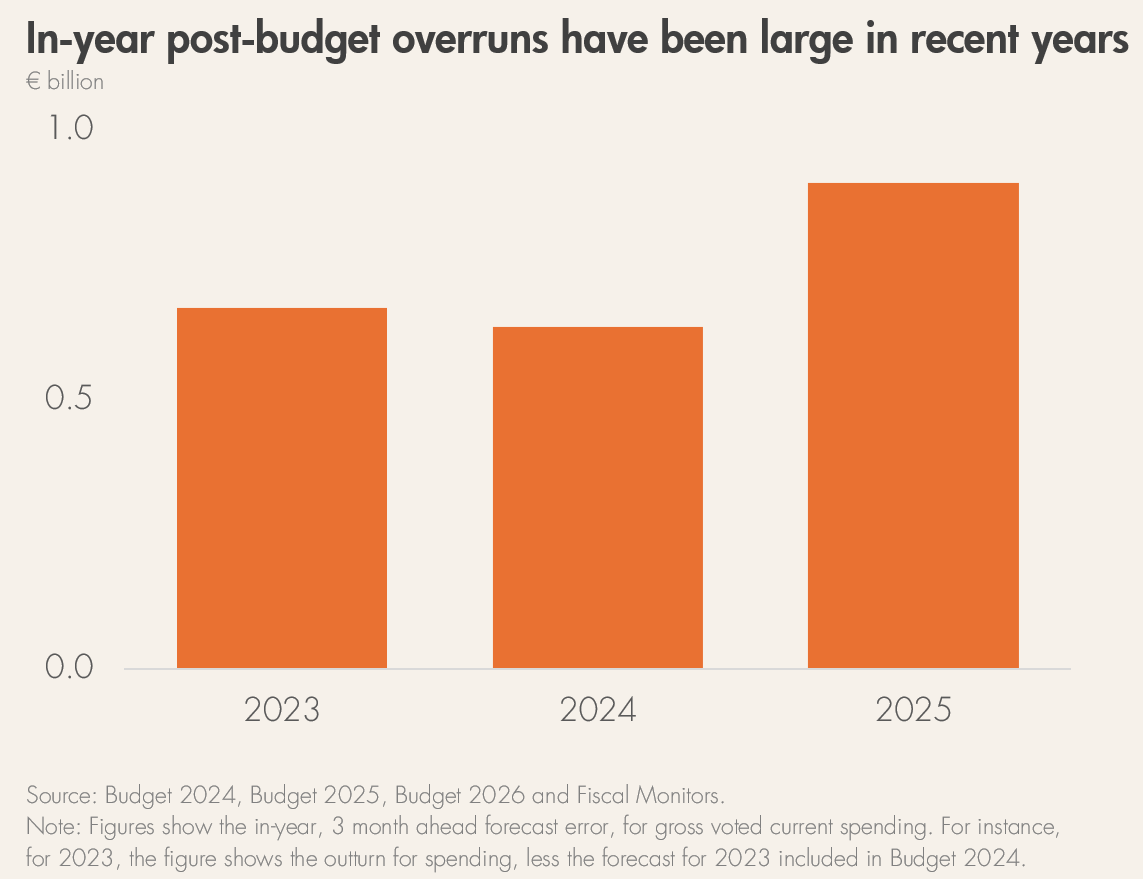
In practical terms, we spent more on teachers, doctors and nurses etc. by December than we’d forecast just three months earlier in October. Since these workers remain employed the following year, next year’s costs will naturally be higher too. The bad budgeting in the base year spills over into the following year.
Was this predictable? Yes. The Fiscal Council has warned for three consecutive years that the starting point was wrong. The Department of Public Expenditure has consistently underestimated the cost of maintaining existing services.
Why does this keep happening and what should be done about it?
The Department of Public Expenditure argues that other departments should manage within agreed funding levels—blaming poor expenditure management.
They have a point, to an extent and a significant proportion of the overruns do appear to be from poor expenditure management. But we have clearly seen evidence of bad budgeting.
The budgetary allocation was too low from the start. Delivering planned services on budget becomes nearly impossible if funding was never sufficient. That responsibility lies with the Department of Public Expenditure.
A central weakness is that estimates for maintaining existing service levels, prior to any policy changes, emerge from negotiations between spending departments and the Department of Public Expenditure, rather than transparent, evidence-based analysis on the likely impact of demographic changes and price pressures. These estimates mix demographic and price pressures with savings estimates which may or may not be realistic.
A better and more transparent approach would be to:
- Estimate the cost of existing services based on actual year-to-date spending—not original allocations, as is the current approach
- Publish estimates of the change in cost of existing services, decomposed into its causes: demographics, pay, and price pressures
- Only then, set and publish estimates of savings targets (following negotiation)
- Publish both the existing-level-of-services estimate and the savings target separately
- Evaluate, after the fact, whether existing-level-of-service estimates were accurate and whether the estimated savings targets were appropriate
This transparency would allow us to determine whether overruns stem from flawed service-cost estimates, unrealistic savings targets, or poorly costed new measures. Currently, we can’t tell. We have no visibility into whether efficiency targets are being met, whether they were realistic to begin with, or whether demographic costs are being properly estimated.
Where does that leave us?
Post-budget overruns create problems for the following year. Budget 2026 made the same mistake again: baseline current spending in 2025 ended up €0.9 billion higher than forecast just three months earlier.
Budget 2026 did include a contingency for unforeseen events. But by January, only €0.4 billion of that contingency remained—well short of the €0.9 billion post-budget overrun. Since then, we have seen energy supports announced, essentially wiping out the contingency, and an extra €0.7 billion of education spending. Spending is likely to overrun further in 2026.
Year after year, we repeat the same mistakes expecting different results. Now is the time to shout stop.
The opinions expressed and arguments employed in these blogs do not necessarily reflect the official views of the Fiscal Council.