
This “Flash Release” gives a preliminary analysis of Budget 2022 and some of the key areas that the Council will explore in its next Fiscal Assessment Report (due out in November).
The economy looks set to recover more strongly than was expected
The economy looks set to recover to above pre-pandemic levels this year.
The Department assumes some degree of scarring over the medium term.
There are risks that…

Economy set to recover
Official estimates suggest that the Irish economy fell well below normal levels of activity in 2020 and 2021 amid the pandemic.[2]
This means that there were lots of unused resources in the economy and plenty of scope for activity to be boosted. Good economic management suggests that policy was right to support incomes and demand amid these conditions. As the economy recovers, it will be possible to unwind the temporary supports provided.
The estimates produced by the Department suggest that the economy will recover most all of its potential by next year.
The deficit recovered in 2021 as restrictions were eased. The deficits are projected to close in the coming years.
The Government is expected to have run large deficits in 2020 and 2021 of €18.4 billion and €13.2 billion (equivalent to 5.9% and 3.4% of modified GNI*, respectively).
However, the recovery in receipts coupled with spending restraint is projected to help close the deficit by 2024.
High spending is the key driver of the deficit
A large gap between government spending and government revenue opened up in 2020 amid the costs of the pandemic.
This reflected a substantial increase in spending on health, income and business supports associated with the impact of the pandemic. Revenues fell amid weaker economic activity, but many taxes were resilient.
Government spending rose sharply in 2020 and is expected to reach 52.2 per cent of GNI* for the year. Revenues are likely to be equivalent to 41.5 per cent of GNI* this year.
Budget 2021 shows that the gap should close somewhat next year. Spending would be lower again for 2021 should contingencies set aside for a no-deal Brexit and risks associated with Covid-19 not be utilised.
The Government debt ratio is projected to fall from very high levels
Ireland’s Government debt burden was high going into the pandemic and increased sharply as a result of supports.
As a share of modified gross national income (nominal GNI*), gross debt is set to peak at 106.2% of GNI* at the end of this year, falling to 89.5% in 2025.
Net debt, which excludes cash and other liquid assets, is forecast to rise to be 90.4% of GNI* at the end of 2021, and is projected to fall at a steady pace towards 79.2% GNI* by 2025.
Significant increases in recurring spending are planned
Budget 2021 sets out significant increases in “core” gross voted current spending for 2021. This recurring spending is unrelated to Covid-19 and Brexit.
The recurring spending increases include €1.8 billion in Health spending and €0.5 billion for Education plus Research, Innovation and Science areas.
There is little indication of how these increases will be financed on a sustainable basis after the immediate crisis has subsided and once the recovery has become well entrenched.
There is also a risk that some of the spending related to Covid-19 becomes more long-lasting than is currently planned.
Annual public investment spending is set to remain at high levels
Public investment spending is planned to be €9.8 billion in 2021 (4.7 per cent of GNI*).
This represents an increase of €580 million compared to spending in 2020 and is €6.3 billion higher than in 2012 when investment levels were at their lowest in recent decades.
Growth before and after the budget
The policy measures announced on budget day as part of Budget 2021 are estimated to boost growth in underlying domestic demand by almost 0.5 percentage points in 2020 and by 1 percentage point in 2021.
This is based on a comparison of the pre-Budget forecasts (endorsed by the Fiscal Council) and the post-Budget forecasts.
Key taxes are expected to remain weak in 2021
Income tax, VAT and Excise tax receipts are expected to remain relatively weak throughout 2021 as a result of the impact of the pandemic and an assumed hard Brexit.
This chart shows the tax heads seasonally adjusted and set relative to their January 2020 levels (set as equal to 100 for that month). It highlights the sharp fall in receipts as confinement measures took hold from March 2020 onwards, followed by the recovery in receipts as these measures were lifted.
Corporation tax risks
Tax revenues are now very reliant on corporation tax receipts and are expected to reach a record of almost 21.7 per cent of tax revenue this year. The average for 1995-2019 was 13.8 per cent.
The strength of corporation tax receipts has been a key factor in terms of the overall resilience of tax receipts during the pandemic.
Budget 2021 forecasts suggest this reliance will remain, with corporation tax revenues expected to remain high at 21.5 per cent of tax revenue in 2021.
Long-term risks include ageing costs and climate change
The Government plans to publish a medium-term recovery plan in spring 2021 that will set out its strategy for emerging from the crisis.
In the medium term, the Government will need to balance competing pressures. These include a weaker underlying budget position, the need to reduce public debt, rising ageing costs, reducing the overreliance on corporation tax, addressing climate change and meeting social objectives as set out in the Programme for Government, particularly around health and housing.
In the long term, the Fiscal Council estimates that, under current policies, ageing-related costs will add to the government debt burden over time. Around half the government debt burden in 2050 would reflect unfunded ageing costs.
The Government deferred a planned pension age increase previously legislated for in 2021. The pension age was set to rise from 66 to 67. The Government will set up a Commission on Pensions to consider future changes to the pension system but has not set out a timeline.
See the Council’s recent Long-term Sustainability Report for more information.
An improved budgetary framework would help
Dealing with the challenges posed by Covid-19, an ageing population and climate change will require careful planning and monitoring
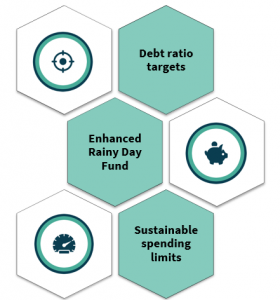
The Government has committed to producing a fiscal strategy in spring of next year. It is vital that further delays are not introduced.
The Council assesses that three key reforms to the fiscal framework would help to chart a prudent path for managing the public finances in coming years. These would include: debt ratio targets; an enhanced rainy day fund; and sustainable spending limits. Read more in our recent Pre-Budget 2021 Statement.